Why Car Batteries Die in the Cold
Why a car battery struggles in cold weather, the warning signs, when to get a car battery test, and what EV owners should know about the 12-volt battery.
By David Hain
Service Manager, North Bay Cadillac and North Bay GMC
Reviewed by John Campanelli, Executive Manager, North Bay GMC
Updated · 5 min read
Key points
- Cold slows the chemical reaction inside a car battery, so it delivers less power just when a cold engine needs more to start.
- A battery that was already weak often fails on the first hard freeze, so a car battery test in the fall is the best way to avoid a no-start.
- NHTSA recommends having a mechanic check the battery's voltage, amperage and reserve capacity, along with the charging system and belts, before winter.
- Electric vehicles, including the GMC Sierra EV and HUMMER EV, still have a 12-volt battery, and a no-start on an EV is often a 12-volt problem.
Car batteries die in the cold because low temperatures slow the chemical reaction that makes their power, while a cold engine needs more power to start. A battery that was already tired often gives out on the first hard freeze. A quick battery test in the fall, clean connections and regular driving go a long way toward avoiding a dead battery on a January morning.
Fall
Best time for a battery test
Before the first hard freeze
3 checks
Voltage, amperage, reserve capacity
NHTSA's pre-winter battery advice
2 batteries
In an electric vehicle
High-voltage plus a 12-volt
Every winter, the first cold snap brings a wave of no-start calls to our service department at North Bay GMC. Drivers in Great Neck and Manhasset who had no trouble in October suddenly hear a slow crank, or nothing at all. In most cases the battery was already weak, and the cold simply exposed it. Here is why it happens and how to stay ahead of it.
Why cold weather drains a car battery
Cold weather reduces how much power a car battery can deliver and increases how much the engine needs.
A standard 12-volt car battery makes electricity through a chemical reaction. That reaction slows down as the temperature falls, so the battery has less power available on a cold morning than on a mild one. At the same time, engine oil thickens in the cold, and a cold engine takes more effort to turn over. Less supply and more demand is a bad combination.
Winter adds other loads too. Heated seats, a heated steering wheel, rear defrost, headlights in the early dark and the blower on high all draw power. Short trips around town, like a run to the LIRR station or a stop on Northern Boulevard, may not give the alternator enough time to recharge the battery fully. Over a few weeks of short winter drives, the charge can slowly run down.
In most cases the battery was already weak, and the cold simply exposed it.
 David HainService Manager, North Bay Cadillac and North Bay GMC
Age matters as well. Batteries lose capacity over the years, and summer heat on Long Island takes its own toll. A battery that has been through several summers may still start the truck in October and then fail when the temperature drops.
Warning signs of a weak battery
A slow crank, dim lights at startup and battery warning messages are the most common signs a battery is close to failing.
Watch and listen for these:
- A slow or labored crank when you start the engine, especially on cold mornings.
- Dim headlights or interior lights when the engine is off or just starting.
- A battery or charging system warning on the instrument cluster or the driver information center.
- Electronics acting up, such as the radio resetting or power accessories behaving oddly at startup.
- Corrosion on the terminals, a white or bluish crust around the battery posts.
- An older battery that has never been tested.
One warning sign is easy to miss: a battery that needs a jump once and then seems fine. A battery that has been fully drained once may not hold a charge as well afterward. If you needed a jump, have the battery and the charging system tested soon, rather than waiting for the next no-start.
“I have been purchasing vehicles from this dealership for many years now and when I asked Laura to find me an exact model that was limited production, she delivered as always with professionalism and expertise. I can’t say enough of everyone here from the finance manger to the service department.”
What a car battery test checks
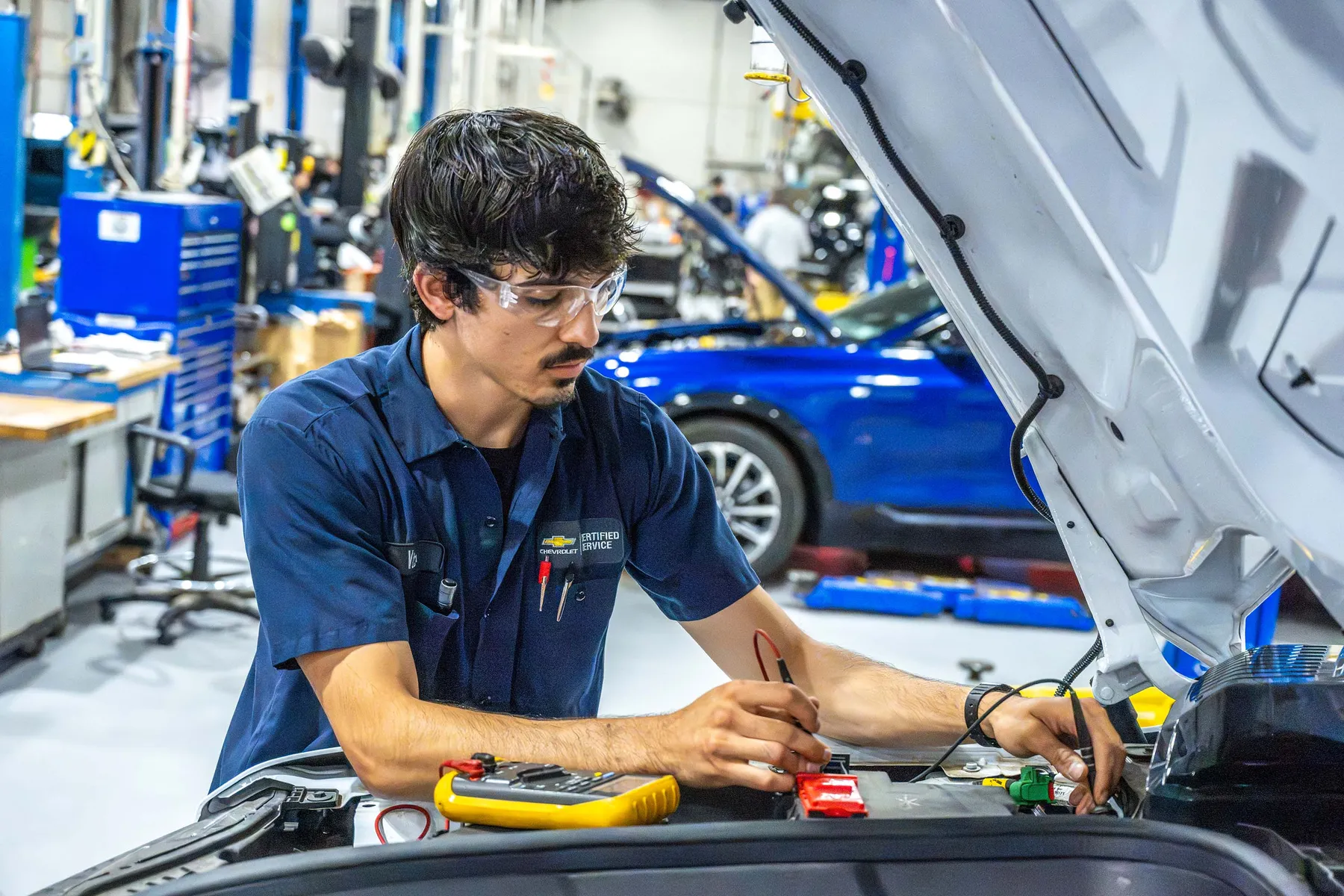
A proper car battery test measures the battery’s condition and checks that the charging system is keeping it charged.
NHTSA’s winter driving guidance recommends having a mechanic check the battery’s voltage, amperage and reserve capacity, along with the charging system and belts. A good test looks at the whole system. A new battery will not last if the alternator is not charging it properly.
| Check | What it tells you |
|---|---|
| Voltage | State of charge |
| Amperage | Starting power |
| Reserve capacity | Power in reserve |
| Charging system | Alternator output |
| Cables and belts | Connections and drive |
Small fixes often come out of a test. Loose or corroded cable connections can be cleaned and tightened, and a battery that is low but healthy can be recharged. A very cold battery can test poorly simply because of its temperature, so a technician may let it warm up or recharge it before deciding it needs replacement.
A new battery will not last if the alternator is not charging it properly.
David HainService Manager, North Bay Cadillac and North Bay GMCThe simplest habit is to ask for a battery test when your truck or SUV is already in for an oil change or a seasonal tire changeover. Our winter car prep checklist includes the battery alongside tires, wipers and fluids.
The 12-volt battery in an EV
Electric vehicles still have a 12-volt battery, and when an EV will not start in the cold, that small battery is often the reason.
An electric GMC such as the Sierra EV or HUMMER EV has two batteries. The large high-voltage battery drives the vehicle. A standard 12-volt battery powers the electronics and lets the vehicle wake up and start. If the 12-volt battery is weak, the vehicle may not start even when the high-voltage battery shows plenty of charge.
GM’s owner information for its electric trucks offers some winter guidance:
- Plug in overnight in cold weather. GM recommends plugging in on colder days so the high-voltage battery can stay warm, then using remote start.
- Avoid leaving it unplugged for days in extreme cold. GM’s Sierra EV owner’s manual warns that parking in extreme cold for several days without the charge cord connected may cause the vehicle not to start.
- Limit Service Mode. The manual notes that Service Mode uses the 12-volt battery, and leaving it on for a long time can leave the vehicle unable to start.
If an electric GMC will not start, check the owner’s manual for the jump-starting procedure for your model, or call roadside assistance. For more on cold-weather EV habits, see preconditioning your EV in winter and what maintenance an EV still needs.
Keep jumper cables, and book a check at North Bay GMC
Carry basic winter gear, keep the battery charged, and have it tested before the cold settles in.
NHTSA suggests keeping jumper cables in the vehicle in winter, along with a flashlight, blankets and a phone charger. If your truck sits for long stretches, such as a second vehicle parked in a Manhasset driveway, a smart battery maintainer can help keep it charged. Drive long enough now and then to let the charging system do its job.
North Bay GMC is at 720 Northern Blvd in Great Neck, and our service department is open Monday to Friday, 7:30 to 6:00. Call 516-466-6200 or book a service visit online and ask for a battery and charging system test with your next appointment. For more care guides, see our Service & Care section.
Questions
Why does cold weather kill car batteries?
Cold weather slows the chemical reaction that produces a car battery's power, so the battery has less to give. At the same time, a cold engine is harder to turn over. A battery that was already weak often cannot keep up on the first cold morning.
How do I get a car battery test?
A service department such as North Bay GMC can test a car battery's condition and the charging system during a visit. NHTSA recommends checking voltage, amperage and reserve capacity, plus the charging system and belts, before winter sets in.
Does an electric vehicle have a 12 volt battery?
Yes. Electric vehicles such as the GMC Sierra EV have a high-voltage battery for driving and a standard 12-volt battery that powers the vehicle's electronics and lets it start up. If the 12-volt battery is weak, the EV may not start even with a full high-voltage battery.
Can I jump-start a GMC electric truck?
Procedures differ by vehicle, so follow the jump-starting section of the owner's manual for your GMC Sierra EV or HUMMER EV. If you are unsure, call roadside assistance or the North Bay GMC service department for guidance.
Written by David Hain with the DriveWise editorial team. Prices, incentives and specifications change, so confirm details with the store before you buy. Editorial standards

Weidinger Auto: Always Moving Forward
Family-owned since 1938 · Six stores on Long Island and in Westchester